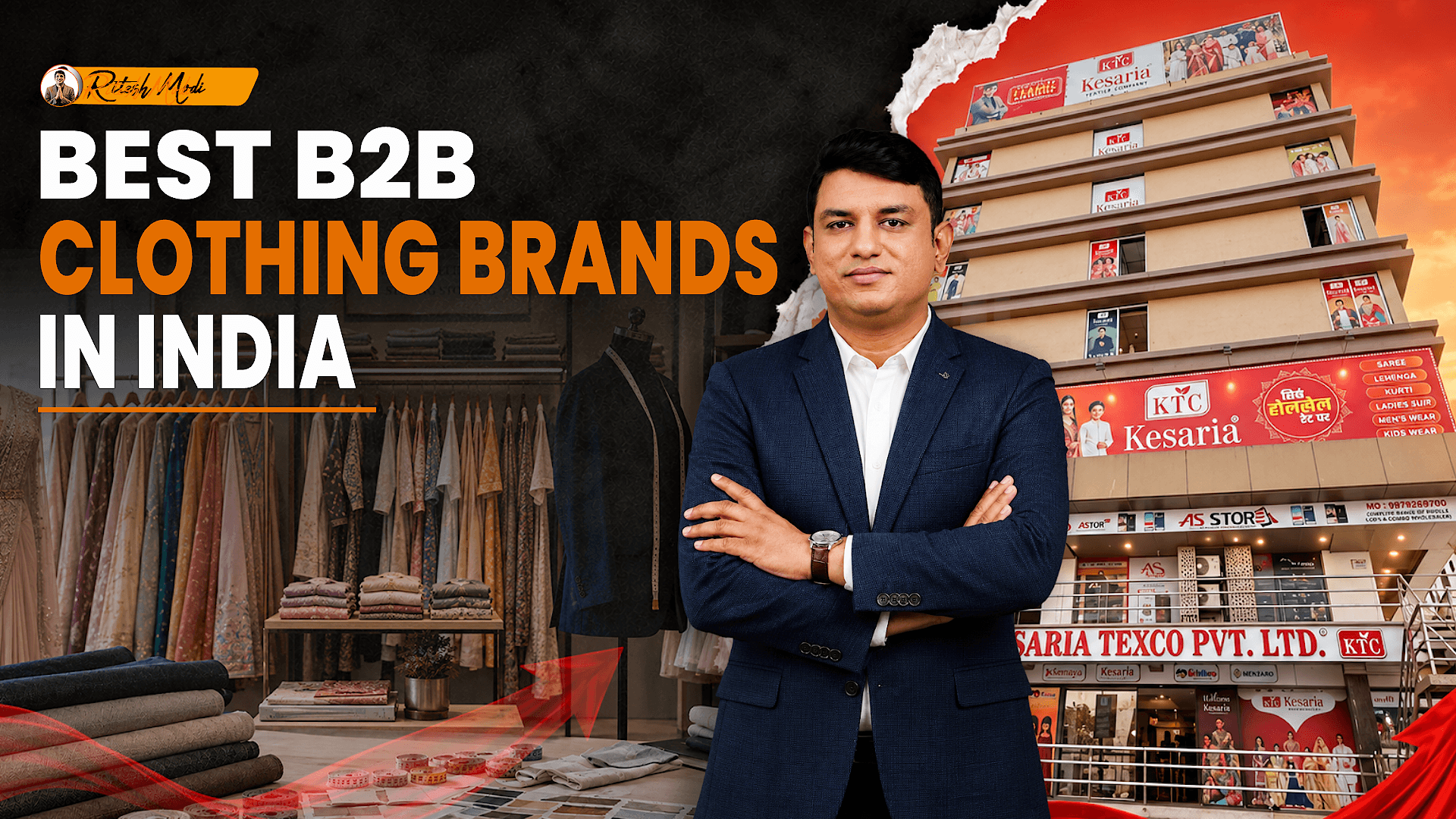
Best B2B Clothing Brands in India: A Business Perspective by Ritesh Modi
India's clothing industry is one of the most dynamic and diverse sectors in the country's business landscape. From traditional sarees and ethnic wear to modern western clothing, men's fashion and kids' collections, the Indian apparel market serves millions of retailers, distributors, resellers and fashion businesses. Behind this huge retail network is a powerful B2B clothing ecosystem, where manufacturers, wholesalers, suppliers and fashion brands work together to bring products from factories to stores across India.
As the CEO & Founder of Kesaria Textile Company, I have closely observed how the B2B clothing market has changed with evolving customer expectations, faster fashion cycles, digital commerce and increasing competition. Today, being a successful B2B clothing brand is not simply about offering garments at wholesale prices. Retailers and resellers are looking for a complete business partner that can provide consistent quality, attractive designs, competitive pricing, dependable supply, product variety and professional service.
When people search for the best B2B clothing brands in India, they are often looking for more than a list of companies. They want to understand which businesses can genuinely support their clothing journey. Whether someone is starting a clothing store, expanding an existing retail business, selling through social media, operating an online fashion store or building a distribution network, choosing the right B2B clothing supplier can have a direct impact on profitability and long-term growth.
This article shares my perspective on the Indian B2B clothing industry, the qualities that define a strong wholesale clothing brand, and why manufacturing capability, product diversity and a reliable supply chain matter so much in today's market.
What Does B2B Clothing Mean in India?
B2B clothing refers to clothing businesses that primarily supply apparel to other businesses instead of selling individual garments directly to consumers. Their customers may include clothing retailers, wholesalers, distributors, resellers, boutiques, online sellers, fashion stores and franchise businesses.
The B2B model creates a connection between the manufacturing and retail sides of the fashion industry. A manufacturer may produce garments in large quantities, while a B2B supplier or wholesale brand makes those products accessible to retailers and business buyers. The retailer can then sell the products to the final customer.
For example, a clothing retailer may need sarees, kurtis, lehengas, suits, western wear, men's shirts or kids' clothing in multiple designs and quantities. Instead of sourcing every category from different places, a strong B2B clothing company can become a single sourcing partner. This can simplify purchasing, improve inventory planning and help retailers build a broader product range.
In my view, this is where the real strength of a B2B clothing brand lies: not just selling products, but helping another business sell successfully.
What Makes the Best B2B Clothing Brands in India?
The Indian B2B fashion market is highly competitive. Hundreds of manufacturers, wholesalers and suppliers operate across major textile and apparel hubs. However, not every supplier provides the same level of product quality, service or business support.
A strong B2B clothing brand generally stands on several important foundations.
1. Strong Manufacturing and Sourcing Capability
A reliable supply chain begins with dependable manufacturing and sourcing. When a clothing company has strong relationships with production units and understands fabrics, designs, finishing, stitching and quality control, it can respond better to changing market demand.
Manufacturing knowledge also allows a B2B company to understand the actual cost structure of a garment and work toward competitive wholesale pricing. For retailers, this can be extremely important because their final business success depends on the relationship between purchase price, selling price, product demand and inventory turnover.
India has several major textile and apparel hubs, and Surat has become particularly important for fabrics, sarees, women's ethnic wear and fashion manufacturing. The combination of textile expertise, manufacturing infrastructure and a large supplier network makes Surat an important destination for clothing businesses.
2. Wide Clothing Product Range
Retailers increasingly prefer suppliers who can provide multiple categories. A diversified product portfolio allows a retailer to serve different customer groups while reducing the need to manage numerous suppliers.
A comprehensive B2B clothing portfolio may include:
- Sarees
- Kurtis
- Salwar Suits
- Lehengas
- Gowns
- Women's Western Wear
- Dupattas
- Blouses
- Nightwear
- Men's Shirts
- T-Shirts
- Trousers
- Jeans
- Ethnic Wear
- Kurta Pajama
- Sherwani
- Men's Suits & Blazers
- Track Pants & Joggers
- Kids Wear
- Boys' Clothing
- Girls' Clothing
The advantage of such a product ecosystem is simple: one business relationship can potentially serve multiple sections of a retailer's store.
For a growing retailer, this can make procurement more organized and allow the business to experiment with different categories without creating an unnecessarily complicated supplier network.
3. Competitive Wholesale Pricing
Price is one of the most important factors in B2B clothing. Retailers purchase with the expectation that they can create a sustainable margin when products are sold to customers.
However, low price alone does not necessarily make a supplier the best choice. A garment with an attractive price but inconsistent quality, poor finishing or weak demand can become expensive inventory for a retailer.
The better approach is value-based wholesale pricing—a balance between product quality, design appeal, manufacturing cost, market demand and expected retail potential.
At Kesaria Textile Company, our B2B approach is built around the understanding that retailers need products that are commercially viable, not simply inexpensive. The objective should be to create a product-price combination that helps a retailer compete in their own market.
4. Consistent Quality
In the clothing business, consistency matters enormously.
A retailer may receive one excellent batch from a supplier, but if the next order has differences in fabric quality, colour, stitching or finishing, customer satisfaction can suffer. Therefore, quality control should be treated as an ongoing process rather than a one-time inspection.
The best B2B clothing businesses focus on areas such as:
Fabric quality → stitching → measurements → colour → finishing → packaging → order accuracy
Consistency creates confidence. When retailers know what they can expect from a supplier, they are more likely to develop a long-term business relationship.
5. Understanding Fashion and Market Trends
Fashion changes continuously. Designs that are highly popular today may have significantly different demand a few months later.
A successful B2B clothing company therefore needs to understand consumer behaviour and retail trends. It needs to monitor colours, fabrics, silhouettes, prints, embroidery, occasions and regional preferences.
India is particularly interesting because fashion preferences can vary significantly from one market to another. A product that performs strongly in one city may have a different demand pattern in another.
This is why successful B2B clothing brands need both manufacturing strength and market understanding.
Kesaria Textile Company: Building a B2B Clothing Business from Surat
My journey in the textile industry has taught me that building a successful clothing company requires a combination of product knowledge, market understanding, relationships and long-term thinking.
Kesaria Textile Company is focused on the B2B clothing ecosystem, serving businesses that require apparel for resale and commercial use. Our approach is connected to the direct factory-to-business model, with a focus on wholesale clothing across multiple categories.
The objective is not simply to become another name among clothing suppliers. The larger vision is to build a dependable B2B platform where retailers, resellers and fashion entrepreneurs can source products and develop their businesses with greater confidence.
Our product ecosystem covers women's wear, men's wear and kids' wear, allowing business buyers to explore a broad range of fashion requirements through one established clothing network.
For B2B customers, this broader approach can be particularly useful because fashion businesses often need different product categories throughout the year.
Why Surat Is Important for B2B Clothing in India
When discussing the best B2B clothing brands in India, it is difficult to ignore Surat's contribution to the textile and apparel industry.
Surat has developed a strong ecosystem around textiles, fabrics, processing, manufacturing, wholesale trading and fashion distribution. Its extensive business network allows manufacturers and suppliers to develop products at scale and distribute them to markets across India.
For a clothing entrepreneur, sourcing from a major textile hub can provide access to:
- Large product variety
- Textile manufacturing expertise
- Multiple price segments
- Fast fashion production
- Wholesale networks
- New designs and collections
- Scalable supply opportunities
The real advantage, however, comes when a supplier combines this ecosystem with strong quality control and professional B2B service.
B2B Clothing Brands Should Think Beyond Wholesale Orders
One of the biggest changes I have observed in the clothing industry is the increasing importance of business support.
A retailer does not simply need a supplier. They need a partner who understands their commercial challenges.
A modern B2B clothing company should think about questions such as:
What products are currently in demand?
What price range will work for the retailer's market?
How frequently should new collections be introduced?
How can inventory risk be reduced?
How can retailers access products efficiently?
These questions move the relationship from a simple buyer-seller transaction toward a long-term business partnership.
The Role of Technology in B2B Clothing
Technology is changing the way clothing businesses discover, evaluate and purchase products.
Earlier, wholesale buyers often depended heavily on physical markets, trade networks and personal visits. Today, digital platforms allow retailers to discover manufacturers, compare collections, communicate with suppliers and explore products remotely.
For B2B clothing brands, having a strong digital presence is therefore becoming increasingly important.
A professional B2B clothing website should clearly communicate:
- Company information
- Product categories
- Manufacturing capabilities
- Wholesale policies
- Minimum order requirements
- Contact information
- Business locations
- New collections
- Brand information
- B2B enquiry options
Digital visibility does not replace relationships in the textile industry, but it can make those relationships easier to establish and scale.
How Retailers Can Choose the Right B2B Clothing Brand
If you are a retailer or reseller searching for the best B2B clothing brands in India, I recommend looking beyond advertisements and focusing on practical business factors.
Product Quality
Always understand the quality level of the products before committing to large inventory purchases.
Price Structure
Compare wholesale pricing while considering fabric, finishing, design and expected retail value.
Product Variety
A supplier offering multiple categories can make sourcing easier for a diversified clothing store.
Supply Reliability
A good supplier should have the capability to manage repeat orders and maintain dependable supply.
Business Policies
Understand minimum order requirements, payment terms, shipping arrangements, return policies and other commercial conditions before placing an order.
Communication
Professional communication is particularly important in B2B because orders can involve large quantities and multiple product specifications.
Long-Term Relationship
The best supplier is not necessarily the one offering the cheapest first order. It is often the supplier capable of supporting your business consistently over time.
B2B Clothing Is Creating New Opportunities for Entrepreneurs
The growth of India's fashion market has created opportunities for many types of entrepreneurs.
A person can build a clothing business through a traditional retail store, boutique, online store, social media selling, marketplace selling, distribution or a franchise model.
However, every model depends on one common requirement: reliable product sourcing.
This is why B2B clothing manufacturers and wholesale brands play such an important role in the wider fashion economy.
For a new entrepreneur, the right supplier can help create a product assortment without requiring the entrepreneur to understand every stage of garment manufacturing themselves.
For an established retailer, a reliable B2B supplier can help maintain inventory and introduce new categories.
For a growing reseller, the right wholesale source can provide access to commercially attractive products at business-oriented prices.
The Future of B2B Clothing Brands in India
I believe the future of India's B2B clothing industry will be driven by a combination of manufacturing strength, fashion innovation, digital technology, quality and trust.
The next generation of B2B clothing companies will need to understand both sides of the industry: the manufacturing side and the retailer's business challenge.
Simply producing large quantities will not be enough. Businesses will need to understand what retailers actually require and how fashion demand changes across different markets.
Technology will also continue to make B2B sourcing more convenient. Digital catalogues, online enquiries, product discovery, data-driven inventory planning and direct communication between manufacturers and retailers will become increasingly important.
At the same time, relationships will remain at the heart of the textile business. Clothing is ultimately a product-driven industry, and trust between manufacturer, supplier and retailer remains one of the most valuable assets.
My Perspective as a Textile Entrepreneur
As the Ritesh Modi Textile King Of Surat CEO & Founder of Kesaria Textile Company, I believe the definition of a successful B2B clothing brand should go beyond sales volume.
A strong brand should create value at every stage of the business chain.
The manufacturer should be able to produce efficiently.
The B2B supplier should be able to provide dependable products.
The retailer should be able to sell with confidence.
And ultimately, the customer should receive a product that delivers the expected combination of style, quality and value.
This interconnected approach is what can make India's clothing ecosystem stronger.
For me, the journey of Kesaria Textile Company is not simply about participating in the textile industry. It is about building a long-term B2B clothing ecosystem that connects manufacturing, wholesale, fashion and retail opportunities.
Choosing the Best B2B Clothing Brand in India
There is no single formula that makes one company the perfect B2B clothing brand for every retailer. Different businesses have different requirements based on their location, customer segment, budget, product category and sales model.
However, the fundamentals remain consistent.
Quality. Variety. Pricing. Manufacturing capability. Reliable supply. Fashion understanding. Technology. Service. Trust.
These are the factors that I believe should define the best B2B clothing brands in India.
India's apparel industry has enormous potential, and the B2B segment will remain an important foundation for its growth. As more entrepreneurs enter fashion retail, online selling, reselling and franchise businesses, the demand for dependable clothing manufacturers and wholesale suppliers will continue to increase.
My vision through Kesaria Textile Company is to contribute to this growing ecosystem by creating strong B2B relationships and making quality fashion products accessible to businesses across India.
The future of Indian fashion is not only about what consumers wear—it is also about the businesses, manufacturers and B2B clothing brands working behind the scenes to make that fashion possible.
About Ritesh Modi
Ritesh Modi is the CEO & Founder of Kesaria Textile Company and the founder of Kesaria Bazaar. With an entrepreneurial approach to the textile and apparel industry, he focuses on building scalable B2B clothing opportunities and strengthening connections between manufacturers, suppliers, retailers and fashion entrepreneurs.
Through his professional journey, Ritesh Modi has focused on understanding the changing needs of India's clothing market and developing business models that combine product diversity, wholesale sourcing and long-term business relationships.
His vision is to contribute to the growth of India's textile and fashion ecosystem while creating meaningful opportunities for retailers, resellers and entrepreneurs.